
Precise chemistry. Thoughtful care.
Pool chemistry is a balancing act—not a single number.
We use measured water care to support sanitation, swimmer comfort, and the long-term condition of surfaces and equipment.
Chemistry from a Certified Pool & Spa Operator.
Poolside Experts is CPO Certified through the Pool & Hot Tub Alliance’s Certified Pool & Spa Operator (CPO) program, covering water chemistry, circulation, filtration, and pool-care practices. That training shapes how every reading is taken and every adjustment is made.
About Us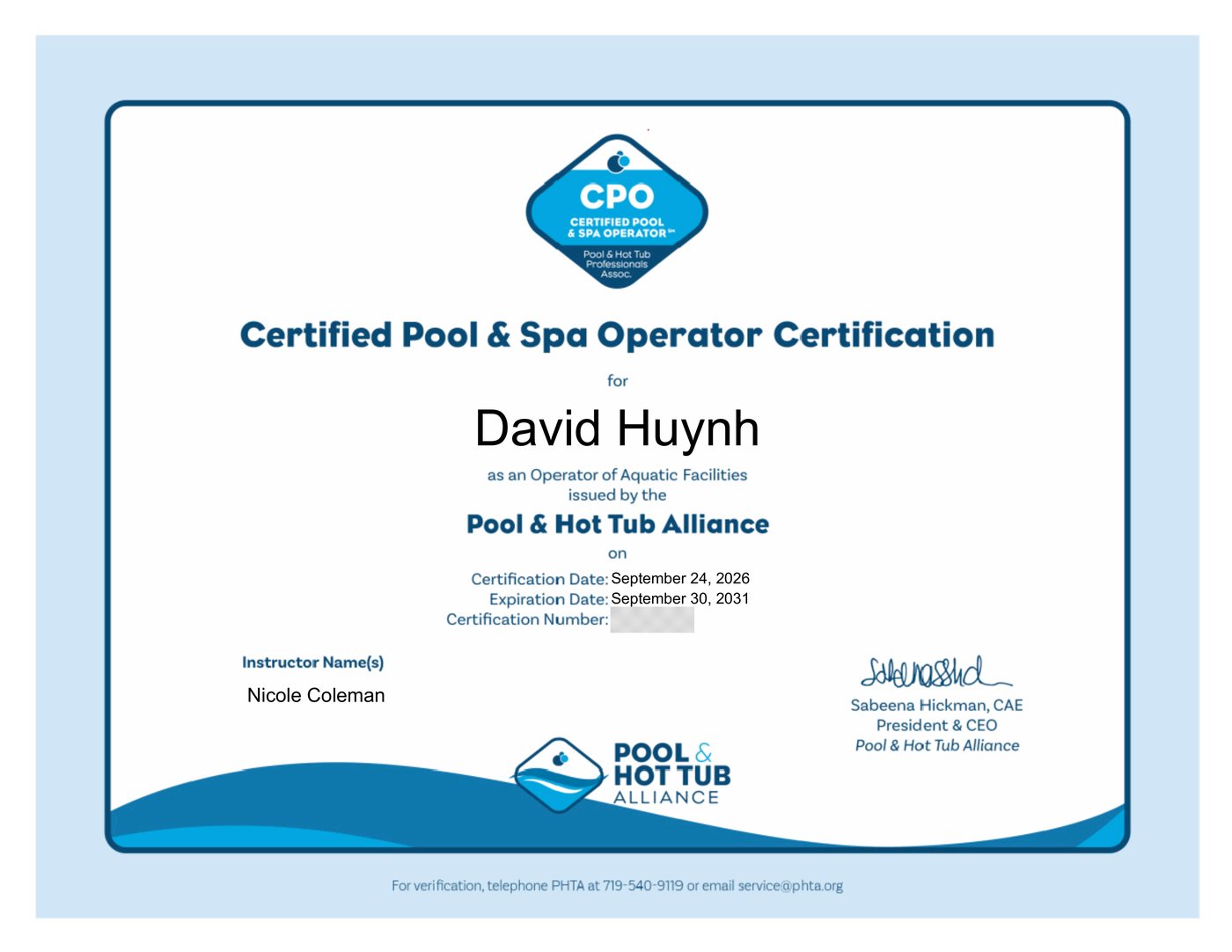
Understand the water. Then adjust it.
Free chlorine (FC)
The sanitizer available to fight germs and algae. The right level depends on stabilizer, product directions, and conditions.
pH
How acidic or basic the water is. It affects sanitizer performance, comfort, and water balance.
Total alkalinity (TA)
The water’s buffering capacity, which helps resist rapid pH changes.
Calcium hardness (CH)
Dissolved calcium. Too much can contribute to scale; too little can contribute to aggressive water in calcium-based surfaces.
Cyanuric acid (CYA)
Stabilizer that protects chlorine from sunlight. Too much can reduce chlorine’s effectiveness and change the required sanitizer level.
Salt
For saltwater chlorine generators, the concentration needs to match equipment specifications.
LSI / saturation index
The Langelier Saturation Index combines factors including pH, calcium, alkalinity, and temperature to assess water’s tendency toward calcium scale or aggressive conditions. It is not a sanitizer or germ-safety test.
Phosphates
A potential nutrient source for algae. We assess them when useful for troubleshooting; phosphate treatment does not replace proper chlorine, brushing, and filtration.
Not every test, every visit
Core sanitizer and pH readings guide weekly adjustments. Broader balance checks, salt readings, and phosphate assessment are performed as appropriate for your pool and conditions—not every parameter at every visit.
Our starting point—not a one-size-fits-all recipe.
These are general reference ranges for many residential pools. We adjust for surface type, temperature, stabilizer, equipment requirements, and product labels. ppm means parts per million.
| Reading | General reference range | What to know |
|---|---|---|
| Free chlorine | 1–3 ppm, only where appropriate | CYA-adjusted: 1 ppm is not appropriate for a stabilized pool. We recommend at least 2 ppm when CYA or stabilized chlorine is used; your pool may require a higher level, including above 3 ppm. Follow product labels and pool-specific guidance. |
| pH | 7.4–7.6 | A practical target band, not the only acceptable range. |
| Total alkalinity | 80–120 ppm | Adjust for sanitizer type and overall water balance. |
| Calcium hardness | 200–400 ppm | Surface requirements and saturation balance matter. |
| Cyanuric acid | 30–50 ppm | A common outdoor-pool reference; salt systems may require a different range. Follow manufacturer guidance. |
| Salt, for saltwater chlorine generators | 2,700–3,400 ppm | Applies to some systems, not all. Your generator’s specified range takes priority. |
| LSI | −0.3 to +0.3 | A balanced reference zone; evaluate with surface and equipment needs. |
Numbers guide care; they do not guarantee water is safe to swim in. Homeowners should check sanitizer and pH between service visits. We recommend checking 2–3 times a week, and more often with heavy use or hot weather. Follow chemical labels and your equipment’s instructions.
Built around the water—and the weather.
Hard water and scale: Calcium-rich source water and evaporation can make scale management important. We consider calcium alongside pH, alkalinity, and temperature.
Heat and sun: Sunlight and summer use can increase chlorine demand. Stabilizer and sanitizer need to be managed together.
Summer algae: Warm conditions make consistent sanitation, circulation, brushing, and filtration especially important.
Santa Ana winds: Windblown leaves and dust add cleanup work and can load baskets and filters. We check debris and equipment conditions at each visit.